psic — Eulerian Six-Circle, 4S+2D (You 1999)#
You (1999) 4S+2D six-circle diffractometer. Four sample stages (mu, eta, chi, and phi) and two detector stages (nu, delta). Transverse detector, vertical scattering plane. Standard synchrotron six-circle.
Coordinate basis: You (1999) (BASIS_YOU): vertical=+x, longitudinal=+y, transverse=+z.
Quick start#
import ad_hoc_diffractometer as ahd

g = ahd.make_geometry("psic")
g.wavelength = 1.0  # Å
print(g.summary())
Demo geometry definition#
This geometry is defined by the psic — Eulerian Six-Circle, 4S+2D (You 1999) factory function — see the source for the complete stage and mode configuration.
Stage layout#
Static fallback (click to expand if the interactive figure above is blank)
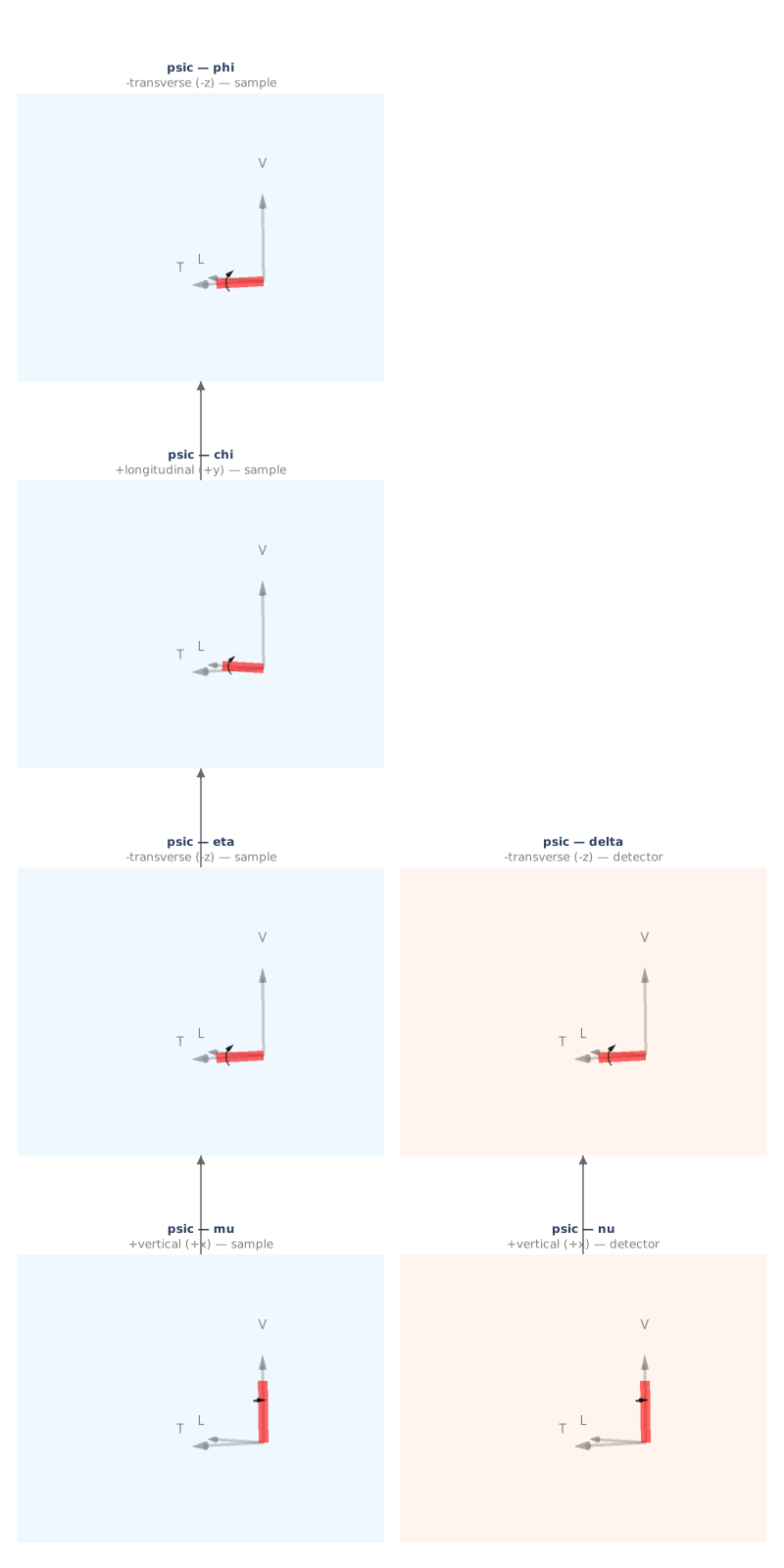
Sample stages (base first):
Stage |
Axis |
Handedness |
Parent |
|---|---|---|---|
|
+vertical (+x) |
right-handed |
base |
|
−transverse (−z) |
left-handed |
|
|
+longitudinal (+y) |
right-handed |
|
|
−transverse (−z) |
left-handed |
|
Detector stages (base first):
Stage |
Axis |
Handedness |
Parent |
|---|---|---|---|
|
+vertical (+x) |
right-handed |
base |
|
−transverse (−z) |
left-handed |
|
Diffraction modes#
Set the active mode with g.mode_name = "<mode>".
Each mode is a ConstraintSet of 3 constraints
(N − 3 = 3 for N = 6 DOF).
See Switch Diffraction Modes for usage and Work with Constraints and Diffraction Modes for
changing constraint values at run time.
Bisect pairs:
Vertical plane: eta (transverse) ↔ delta (transverse) →
eta = delta/2Horizontal plane: mu (vertical) ↔ nu (vertical) →
mu = nu/2
fixed_phi_vertical#
phi held at declared value (default 0°), mu = 0, nu = 0.
Override at run time with g.modes["fixed_phi_vertical"].with_constraint_values(phi=...) — see Work with Constraints and Diffraction Modes.
The scattering plane is locked vertical by mu = 0 and nu = 0;
eta, chi, and delta are solved from the hkl equations.
Computed |
eta, chi, delta |
Constant during |
phi, mu = 0, nu = 0 |
fixed_chi_vertical#
chi held at declared value (default 90°), mu = 0, nu = 0.
Override at run time with g.modes["fixed_chi_vertical"].with_constraint_values(chi=...) — see Work with Constraints and Diffraction Modes.
The scattering plane is locked vertical by mu = 0 and nu = 0;
eta, phi, and delta are solved from the hkl equations.
Computed |
eta, phi, delta |
Constant during |
chi, mu = 0, nu = 0 |
fixed_incidence_vertical#
Incidence angle α_i fixed at declared value (default 0°) in the
vertical scattering plane.
Override at run time with g.modes["fixed_incidence_vertical"].with_constraint_values(incidence=...) — see Work with Constraints and Diffraction Modes.
Set g.surface_normal = (h, k, l) before calling forward().
Computed |
eta, chi, phi, delta |
Constant during |
mu = 0, nu = 0 |
Extras (input) |
n̂ → set |
Extras (output) |
incidence (incidence angle), emergence (exit angle) |
fixed_emergence_vertical#
Exit angle β_out fixed at declared value (default 0°) in the
vertical scattering plane.
Override at run time with g.modes["fixed_emergence_vertical"].with_constraint_values(emergence=...) — see Work with Constraints and Diffraction Modes.
Set g.surface_normal = (h, k, l) before calling forward().
Computed |
eta, chi, phi, delta |
Constant during |
mu = 0, nu = 0 |
Extras (input) |
n̂ → set |
Extras (output) |
incidence, emergence |
incidence_equals_emergence_vertical#
Incidence-equals-emergence (α_i = α_f) condition in the vertical
scattering plane.
Set g.surface_normal = (h, k, l) before calling forward().
Computed |
eta, chi, phi, delta |
Constant during |
mu = 0, nu = 0 |
Extras (input) |
n̂ → set |
Extras (output) |
incidence, emergence |
fixed_psi_vertical#
Issue #264 revision. Vertical scattering plane (nu = 0) with mu
fixed at the user-specified value (default 0) and azimuthal angle ψ
validation. Set g.azimuth = (h, k, l) before calling
forward().
Override the mu pin or the psi target at run time with g.modes["fixed_psi_vertical"].with_constraint_values(mu=..., psi=...) — see Work with Constraints and Diffraction Modes.
The previous bisect(eta, delta) constraint was
dropped per the @jwkim-anl review. The solver returns the
fixed-sample solutions only when the natural ψ for the requested
(h, k, l) matches the stored target; the free angles eta, chi,
phi, and delta jointly satisfy the Bragg condition under the
validated ψ. See Surface Geometry and the Reference Vector.
Computed |
eta, chi, phi, delta |
Constant during |
nu = 0, mu = constraint value, ψ = target |
Extras (input) |
n̂ → set |
Extras (output) |
psi (computed azimuth) |
fixed_incidence_fixed_chi_fixed_phi#
Issue #264. Two sample stages (chi, phi) and the incidence angle
α_i are all fixed; the four remaining angles mu, eta, nu, delta
are solved jointly from the Bragg condition plus the α_i target.
This is a 4-D Newton solve that routes through the
_solve_free_detectors solver (both detector stages float to lift
the detector arm out of plane as needed).
Override any of the three pinned values at run time with g.modes["fixed_incidence_fixed_chi_fixed_phi"].with_constraint_values(chi=..., phi=..., incidence=...) — see Work with Constraints and Diffraction Modes.
Set g.surface_normal = (h, k, l) before calling forward().
Computed |
mu, eta, nu, delta |
Constant during |
chi, phi, α_i = target |
Extras (input) |
n̂ → set |
Extras (output) |
incidence, emergence |
fixed_omega_vertical (default)#
Issue #264. SPEC omega-fixed family in the vertical scattering
plane (mu = 0, nu = 0). omega here is the SPEC OMEGA
pseudo-angle (def OMEGA 'Q[6]') — the angle between the
scattering vector Q and the plane of the chi circle — not the
four-circle stage of the same name. See
omega_pseudo().
The default target is omega = 0; in that special case this is the
vertical bisecting geometry (eta = delta/2), because OMEGA = 0
⇔ Q lies in the chi-circle plane ⇔ bisecting condition.
Non-zero targets tilt Q out of the chi-circle plane and are solved by
a 1-D Newton refinement on the free outer sample stage (eta).
Override the OMEGA target at run time with g.modes["fixed_omega_vertical"].with_constraint_values(omega=...) — see Work with Constraints and Diffraction Modes.
Computed |
eta, chi, phi, delta |
Constant during |
mu = 0, nu = 0, OMEGA = target |
Extras (output) |
omega (computed pseudo-angle) |
double_diffraction_vertical#
Full 4D simultaneous solver in the vertical scattering plane: finds motor
angles where both the primary (h₁,k₁,l₁) and secondary (h₂,k₂,l₂)
reflections satisfy the Ewald sphere condition. Set
mode.extras['h2'], ['k2'], ['l2'] before calling forward().
Computed |
eta, chi, phi, delta |
Constant during |
mu = 0, nu = 0 |
Extras (input) |
h₂, k₂, l₂ (secondary reflection Miller indices) |
zone_vertical#
Zone mode (You 1999 §6, SPEC setmode 5). The scattering vector Q is
confined to the plane spanned by two reciprocal-lattice vectors z0
and z1. A forward(h, k, l) call:
Verifies the requested (h, k, l) lies in the zone plane (within
1e-6 · |Q|). Off-plane requests return an empty solution list and emit a warning.Records the in-plane residual
|Q · n_zone|inmode.extras['in_plane_residual'].Returns the bisecting solutions for in-plane reflections (mu = 0, nu = 0, eta = delta/2; chi and phi orient Q within the plane).
The remaining azimuthal degree of freedom around Q is the canonical
SPEC zone-mode scan (cz/mz macros) and is not exercised by a single
forward() call.
Set the zone-plane vectors before calling forward():
g.modes['zone_vertical'].extras['z0'] = (1, 0, 0)
g.modes['zone_vertical'].extras['z1'] = (0, 1, 0)
Computed |
eta, chi, phi, delta |
Constant during |
mu = 0, nu = 0 |
Extras (input) |
z0, z1 (Miller-index 3-tuples) |
Extras (output) |
in_plane_residual |
fixed_phi_horizontal#
phi held at declared value (default 0°), eta = 0, delta = 0.
Override at run time with g.modes["fixed_phi_horizontal"].with_constraint_values(phi=...) — see Work with Constraints and Diffraction Modes.
The scattering plane is locked horizontal by eta = 0 and delta = 0;
mu, chi, and nu are solved from the hkl equations.
Computed |
mu, chi, nu |
Constant during |
phi, eta = 0, delta = 0 |
fixed_chi_horizontal#
chi held at declared value (default 0°), eta = 0, delta = 0.
Override at run time with g.modes["fixed_chi_horizontal"].with_constraint_values(chi=...) — see Work with Constraints and Diffraction Modes.
The scattering plane is locked horizontal by eta = 0 and delta = 0;
mu, phi, and nu are solved from the hkl equations.
The default chi value differs from the vertical counterpart
(fixed_chi_vertical, default 90°): with eta = 0 the residual
psic sub-geometry places the chi-circle axis along the longitudinal
(beam) direction, so chi = 0 is the value that keeps the phi axis
in the horizontal scattering plane. The four-circle “spinning Q”
value chi = 90° tilts the phi axis out of the horizontal plane and
is kinematically infeasible in this mode.
Computed |
mu, phi, nu |
Constant during |
chi, eta = 0, delta = 0 |
fixed_incidence_horizontal#
Incidence angle α_i fixed at declared value (default 0°) in the
horizontal scattering plane.
Override at run time with g.modes["fixed_incidence_horizontal"].with_constraint_values(incidence=...) — see Work with Constraints and Diffraction Modes.
Set g.surface_normal = (h, k, l) before calling forward().
Computed |
mu, chi, phi, nu |
Constant during |
eta = 0, delta = 0 |
Extras (input) |
n̂ → set |
Extras (output) |
incidence, emergence |
fixed_emergence_horizontal#
Exit angle β_out fixed at declared value (default 0°) in the
horizontal scattering plane.
Override at run time with g.modes["fixed_emergence_horizontal"].with_constraint_values(emergence=...) — see Work with Constraints and Diffraction Modes.
Set g.surface_normal = (h, k, l) before calling forward().
Computed |
mu, chi, phi, nu |
Constant during |
eta = 0, delta = 0 |
Extras (input) |
n̂ → set |
Extras (output) |
incidence, emergence |
incidence_equals_emergence_horizontal#
Incidence-equals-emergence (α_i = α_f) condition in the horizontal
scattering plane.
Set g.surface_normal = (h, k, l) before calling forward().
Computed |
mu, chi, phi, nu |
Constant during |
eta = 0, delta = 0 |
Extras (input) |
n̂ → set |
Extras (output) |
incidence, emergence |
fixed_psi_horizontal#
Issue #264 revision. Horizontal scattering plane (delta = 0) with
eta fixed at the user-specified value (default 0) and azimuthal
angle ψ validation. The previous bisect(mu, nu) constraint was
dropped per the @jwkim-anl review. Free angles mu, chi, phi,
nu jointly satisfy the Bragg condition under the validated ψ.
Override the eta pin or the psi target at run time with g.modes["fixed_psi_horizontal"].with_constraint_values(eta=..., psi=...) — see Work with Constraints and Diffraction Modes.
Computed |
mu, chi, phi, nu |
Constant during |
delta = 0, eta = constraint value, ψ = target |
Extras (input) |
n̂ → set |
Extras (output) |
psi |
fixed_omega_horizontal#
Issue #264. SPEC omega-fixed family in the horizontal scattering
plane (eta = 0, delta = 0). Same OMEGA pseudo-angle definition as
fixed_omega_vertical above; at omega = 0 this is the horizontal
bisecting geometry (mu = nu/2). The free outer sample stage
rocked by the 1-D Newton is mu.
Override the OMEGA target at run time with g.modes["fixed_omega_horizontal"].with_constraint_values(omega=...) — see Work with Constraints and Diffraction Modes.
Computed |
mu, chi, phi, nu |
Constant during |
eta = 0, delta = 0, OMEGA = target |
Extras (output) |
omega (computed pseudo-angle) |
double_diffraction_horizontal#
Full 4D simultaneous solver in the horizontal scattering plane.
Computed |
mu, chi, phi, nu |
Constant during |
eta = 0, delta = 0 |
Extras (input) |
h₂, k₂, l₂ (secondary reflection Miller indices) |
zone_horizontal#
Horizontal-plane analog of zone_vertical. Locks eta = 0,
delta = 0; the bisecting condition mu = nu/2 together with chi,
phi solves any in-plane (h, k, l).
Note that horizontal-plane reachability depends on the orientation of
the zone plane relative to the lab frame. The (h, k, 0) reciprocal
plane (z0=(1,0,0), z1=(0,1,0)) is generally not reachable in the
horizontal scattering geometry under the You (1999) basis convention;
choose a plane that contains a vertical reciprocal direction
(e.g. z0=(1,0,0), z1=(0,0,1)) for reachable horizontal-plane work.
Computed |
mu, chi, phi, nu |
Constant during |
eta = 0, delta = 0 |
Extras (input) |
z0, z1 (Miller-index 3-tuples) |
Extras (output) |
in_plane_residual |
lifting_detector_phi#
Issue #264 revision. Out-of-plane mode: every sample stage except
phi is fixed at zero (mu, eta, chi); both detector stages
(nu, delta) float jointly to satisfy the Bragg condition. The
“lifting detector” effect (nu generally non-zero) emerges naturally
for any (h, k, l) requiring out-of-plane scattering — no explicit
qaz constraint is used.
The free sample DOF is phi, so reflections whose Q lies along the
sample’s phi rotation axis (transverse direction in the rest pose)
are kinematically inaccessible.
Computed |
phi, nu, delta |
Constant during |
mu = 0, eta = 0, chi = 0 |
lifting_detector_mu#
Issue #264 revision. Symmetric counterpart fixing every sample stage
except mu (eta, chi, phi all at zero); mu, nu, delta
float. Reflections with Q along mu’s rotation axis (vertical) are
kinematically inaccessible.
Computed |
mu, nu, delta |
Constant during |
eta = 0, chi = 0, phi = 0 |
lifting_detector_eta#
Issue #264. Symmetric counterpart fixing every sample stage except
eta (mu, chi, phi all at zero); eta, nu, delta float
under the Bragg condition. Reflections with Q along eta’s rotation
axis are kinematically inaccessible.
Computed |
eta, nu, delta |
Constant during |
mu = 0, chi = 0, phi = 0 |
Mode cross-reference#
Each psic mode mapped to its closest analog in SPEC’s psic macros,
the Hkl/Soleil E6C hkl engine, and You (1999).
mode |
SPEC |
Hkl/Soleil E6C |
You (1999) |
|---|---|---|---|
|
|
|
§5.2 |
|
|
|
§5.2 |
|
|
— |
§6.1 |
|
|
— |
§6.2 |
|
|
|
§6.4 |
|
|
— |
§6.1 |
|
|
— |
§5 (Q[6]) |
|
— |
|
§6.5 |
|
|
— |
§6.3 |
|
|
(TODO |
§6 |
|
|
— |
§5.2 |
|
|
— |
§5.2 |
|
|
— |
§6.1 |
|
|
— |
§6.2 |
|
|
|
§6.4 |
|
|
— |
§5 (Q[6]) |
|
— |
|
§6.5 |
|
|
— |
§6.3 |
|
|
(TODO |
§6 |
|
|
|
§5.4 |
|
|
|
§5.4 |
|
|
— |
§5.4 |
The SPEC tuple is (g_mode1, g_mode2, g_mode3, g_mode4, g_mode5),
where g_mode1 selects the scattering plane (1 = horizontal,
2 = vertical, 3 = qaz/lifting-detector), g_mode2 selects an optional
reference-angle constraint (0 = none, 1 = α=β, 2 = α-fixed,
3 = β-fixed, 4 = ψ-fixed), and g_mode3–g_mode5 fix specific motor
angles.
—: no documented analog exists in that package.
†: SPEC mode tuples flagged here are listed by the SPEC documentation
as currently not working (the eta-fixed + chi-fixed and eta-fixed +
phi-fixed combinations under setmode d1 0 s1 s2); the
ad_hoc_diffractometer implementation of these modes is independent of
SPEC and works as documented above.
‡: SPEC mode tuples flagged here are reconstructed from the
setmode 0 0 s1 s2 s3 (“three-sample-fixed”) and setmode 0 d2 …
families used in @jwkim-anl’s review on issue #264. They map to the
revised psic modes (no qaz constraint, three sample stages frozen,
both detector stages free); SPEC’s exact tuple may differ slightly
depending on the specific instrument’s setmode macro selectors.
References:
SPEC psic macros;
Hkl/Soleil E6C;
Hkl source.
API reference#
References#
You, J. Appl. Cryst. 32, 614–623 (1999). DOI: 10.1107/S0021889899001223
Walko, Ref. Module Mater. Sci. Mater. Eng. (2016).