kappa6c — Kappa Six-Circle#
Six-circle kappa diffractometer with psic-style outer axes (mu, nu). The inner sample axes (komega, kappa, and kphi) replace the Eulerian chi circle. Transverse detector, vertical scattering plane.
Coordinate basis: You (1999) (BASIS_YOU): vertical=+x, longitudinal=+y, transverse=+z.
Quick start#
import ad_hoc_diffractometer as ahd

g = ahd.make_geometry("kappa6c")
g.wavelength = 1.0  # Å
print(g.summary())
Demo geometry definition#
This geometry is defined by the kappa6c — Kappa Six-Circle factory function — see the source for the complete stage and mode configuration.
Stage layout#
Static fallback (click to expand if the interactive figure above is blank)
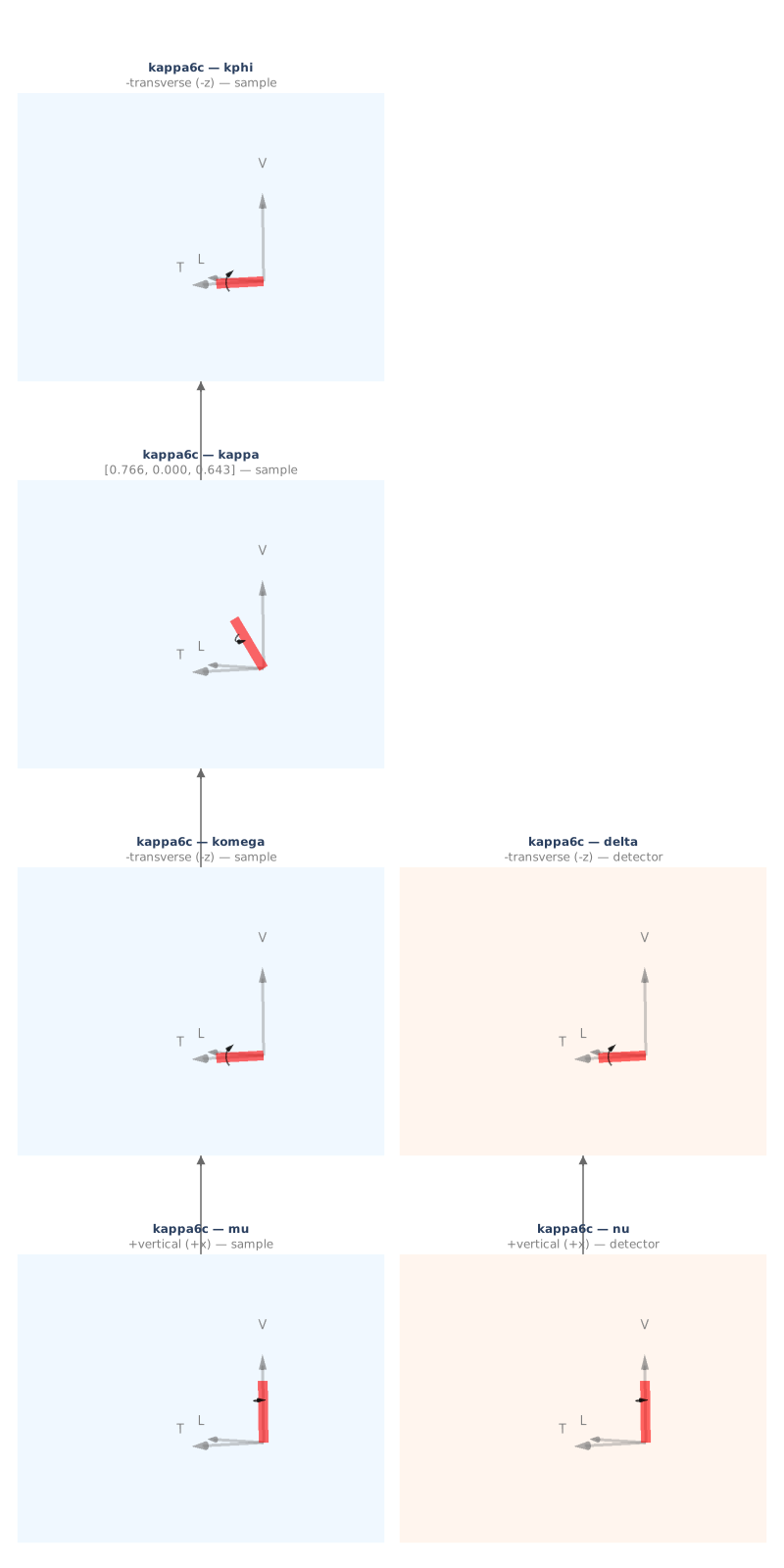
Sample stages (base first):
Stage |
Axis |
Handedness |
Parent |
|---|---|---|---|
|
vertical (+x in You) |
right-handed |
base |
|
transverse (−z in You) |
left-handed |
|
|
(cos α)·transverse + (sin α)·vertical = (cos α)·ẑ + (sin α)·x̂ in You (α = 50°) |
right-handed |
|
|
transverse (−z in You) |
left-handed |
|
Detector stages (base first):
Stage |
Axis |
Handedness |
Parent |
|---|---|---|---|
|
vertical (+x in You) |
right-handed |
base |
|
transverse (−z in You) |
left-handed |
|
How the kappa axis is defined#
kappa6c is structurally the
kappa4cv sample stack mounted on
top of the You (1999) mu and nu outer axes. The kappa
rotation axis is therefore inclined by α from the omega axis,
lying in the plane that contains both omega and the
equivalent-Eulerian chi axis, and tilted from omega toward that chi
direction (Walko 2016 §4.1; ITC Vol. C §2.2.6.2: “the κ axis is
inclined at 50° to the ω axis”).
For kappa6c the omega axis lies along the transverse line
and the equivalent-Eulerian chi axis lies along the vertical
direction. The kappa arm therefore lies in the transverse–
vertical plane, tilted by α from the transverse line toward
+V:
In the You basis (V=+x̂, L=+ŷ, T=+ẑ) at α = 50° this is
The longitudinal component is exactly zero: at mu = 0 the
kappa arm rises upward and outward in the vertical plane
perpendicular to the incident beam, exactly as in kappa4cv.
Published references. The kappa-arm orientation matches Walko (2016) Figure 3 and the canonical κ-goniostat axes in Thorkildsen et al. (2006) Table 1 and equation (3). Sønsteby et al. (2013) describes the six-axis κ-diffractometer (“KUMA6”) at SNBL/ESRF BM01A whose angular calculations follow Thorkildsen (2006); §3 of Thorkildsen (2006) explicitly notes that “additional rotation axes in the goniostat design are easily incorporated in the formalism”. No single published figure depicts the kappa6c-on-mu-nu composite directly; this preset constructs it from the kappa4cv sample stack and the psic outer axes.
Virtual Eulerian angles omega, chi, phi are mapped
to / from the real motors via the geometry-aware decomposition in
eulerian_to_kappa_axes() and
kappa_to_eulerian_axes().
Bisect pairs:
Vertical: komega (transverse) ↔ delta (transverse) →
komega = delta/2Horizontal: mu (vertical) ↔ nu (vertical) →
mu = nu/2
Diffraction modes#
Each mode is a ConstraintSet of 3 constraints
(N − 3 = 3 for N = 6 DOF).
See Switch Diffraction Modes for usage and Work with Constraints and Diffraction Modes for
changing constraint values at run time.
bisecting_vertical (default)#
VirtualBisectConstraint +
SampleConstraint +
DetectorConstraint:
omega_virtual = delta / 2, mu = 0, nu = 0. The
virtual-bisect condition is on the virtual Eulerian omega
pseudoangle and is solved via the geometry-aware
eulerian_to_kappa_axes()
decomposition.
Vertical scattering plane (psic-style).
Computed |
komega, kappa, kphi, delta |
Constant during |
mu = 0, nu = 0 |
fixed_kphi#
SampleConstraint:
kphi held at declared value (default 0°), mu = 0, nu = 0.
Override at run time with g.modes["fixed_kphi"].with_constraint_values(kphi=...) — see Work with Constraints and Diffraction Modes.
Computed |
komega, kappa, delta |
Constant during |
kphi, mu = 0, nu = 0 |
fixed_mu#
SampleConstraint + BisectConstraint + DetectorConstraint:
mu held at declared value (default 0°), komega = delta/2, nu = 0.
Override at run time with g.modes["fixed_mu"].with_constraint_values(mu=...) — see Work with Constraints and Diffraction Modes.
Computed |
komega, kappa, kphi, delta |
Constant during |
mu, nu = 0 |
fixed_nu#
DetectorConstraint + BisectConstraint + SampleConstraint:
nu held at declared value (default 0°), komega = delta/2, mu = 0.
Analogous to psic fixed_nu.
Override at run time with g.modes["fixed_nu"].with_constraint_values(nu=...) — see Work with Constraints and Diffraction Modes.
Computed |
komega, kappa, kphi, delta |
Constant during |
nu, mu = 0 |
fixed_psi_vertical#
Vertical bisecting with azimuthal angle ψ validation.
Set g.azimuth = (h, k, l) before calling forward().
The solver returns bisecting solutions only when the natural ψ for the
requested (h,k,l) matches the stored target. See Surface Geometry and the Reference Vector.
Override the ψ target at run time with g.modes["fixed_psi_vertical"].with_constraint_values(psi=...) — see Work with Constraints and Diffraction Modes.
Computed |
komega, kappa, kphi, delta |
Constant during |
mu = 0, nu = 0 |
Extras (input) |
n̂ → set |
Extras (output) |
psi (computed azimuth) |
double_diffraction_vertical#
Full 4D simultaneous solver in the vertical scattering plane: finds motor angles where both the primary (h₁,k₁,l₁) and secondary (h₂,k₂,l₂) reflections satisfy the Ewald sphere condition.
Computed |
komega, kappa, kphi, delta |
Constant during |
mu = 0, nu = 0 |
Extras (input) |
h₂, k₂, l₂ (secondary reflection Miller indices) |
zone_vertical#
Zone mode (You 1999 §6, SPEC setmode 5). Q is confined to the plane
spanned by two reciprocal-lattice vectors z0 and z1. Structurally
identical to the psic zone_vertical mode, with the bisecting condition
enforced on the virtual Eulerian omega pseudoangle (Walko 2016
eq. [16]) rather than the literal komega motor. Off-plane requests
return an empty list with a warning.
g.modes['zone_vertical'].extras['z0'] = (1, 0, 0)
g.modes['zone_vertical'].extras['z1'] = (0, 1, 0)
Computed |
komega, kappa, kphi, delta |
Constant during |
mu = 0, nu = 0 |
Extras (input) |
z0, z1 (Miller-index 3-tuples) |
Extras (output) |
in_plane_residual |
bisecting_horizontal#
BisectConstraint + SampleConstraint + DetectorConstraint:
mu = nu/2, komega = 0, delta = 0.
Horizontal scattering plane.
Computed |
mu, kappa, kphi, nu |
Constant during |
komega = 0, delta = 0 |
fixed_delta#
DetectorConstraint + BisectConstraint + SampleConstraint:
delta held at declared value (default 0°), mu = nu/2, komega = 0.
Horizontal plane with delta frozen.
Override at run time with g.modes["fixed_delta"].with_constraint_values(delta=...) — see Work with Constraints and Diffraction Modes.
Computed |
mu, kappa, kphi, nu |
Constant during |
delta, komega = 0 |
fixed_psi_horizontal#
Horizontal bisecting with azimuthal angle ψ validation.
Symmetric with fixed_psi_vertical in the horizontal plane.
Set g.azimuth = (h, k, l) before calling forward().
Override the ψ target at run time with g.modes["fixed_psi_horizontal"].with_constraint_values(psi=...) — see Work with Constraints and Diffraction Modes.
Computed |
mu, kappa, kphi, nu |
Constant during |
komega = 0, delta = 0 |
Extras (input) |
n̂ → set |
Extras (output) |
psi (computed azimuth) |
double_diffraction_horizontal#
Full 4D simultaneous solver in the horizontal scattering plane.
Computed |
mu, kappa, kphi, nu |
Constant during |
komega = 0, delta = 0 |
Extras (input) |
h₂, k₂, l₂ (secondary reflection Miller indices) |
zone_horizontal#
Horizontal-plane analog of zone_vertical. Locks komega = 0,
delta = 0; the bisecting condition mu = nu/2 together with the
kappa motor pair solves any in-plane (h, k, l).
Computed |
mu, kappa, kphi, nu |
Constant during |
komega = 0, delta = 0 |
Extras (input) |
z0, z1 (Miller-index 3-tuples) |
Extras (output) |
in_plane_residual |
lifting_detector_mu#
Out-of-plane mode: mu and komega frozen, nu and delta solved via the qaz
constraint (tan(qaz) = tan(delta) / sin(nu), You 1999 eq. 18).
qaz = 90° constrains the scattering to the vertical plane.
Computed |
mu, nu, delta |
Constant during |
mu = 0, komega = 0 |
lifting_detector_kphi#
Out-of-plane mode: kphi and mu frozen, nu and delta solved via the qaz
constraint (tan(qaz) = tan(delta) / sin(nu), You 1999 eq. 18).
qaz = 90° constrains the scattering to the vertical plane.
Computed |
kphi, nu, delta |
Constant during |
kphi = 0, mu = 0 |
Mode cross-reference#
Each kappa6c mode mapped to its equivalent psic mode (the kappa6c
geometry shares the psic outer-axis ordering), the closest analog in
SPEC’s kappa6c macros, and the Hkl/Soleil K6C hkl engine. Modes
are grouped by scattering plane: vertical first, then horizontal, then
the out-of-plane lifting-detector family.
mode |
psic equivalent |
SPEC |
Hkl/Soleil K6C |
|---|---|---|---|
|
|
|
|
|
|
|
|
|
— |
|
— |
|
— |
|
— |
|
|
|
|
|
|
— |
|
|
|
|
(TODO |
|
|
|
|
|
— |
|
— |
|
|
|
|
|
|
— |
|
|
|
|
(TODO |
|
|
|
|
|
|
|
|
The SPEC tuple is (g_mode1, g_mode2, g_mode3, g_mode4, g_mode5),
where g_mode1 selects the scattering plane (1 = horizontal,
2 = vertical, 3 = qaz/lifting-detector), g_mode2 selects an optional
reference-angle constraint (0 = none, 4 = ψ-fixed), and
g_mode3–g_mode5 fix specific motor angles.
—: no documented analog exists in that package.
References:
SPEC kappa6c macros;
Hkl/Soleil K6C;
Hkl source.
API reference#
References#
H.H. Sønsteby, D. Chernyshov, M. Getz, O. Nilsen & H. Fjellvåg, On the application of a single-crystal κ-diffractometer and a CCD area detector for studies of thin films, J. Synchrotron Rad. 20, 644–647 (2013) (six-axis κ instrument; KUMA6 at SNBL/ESRF). DOI: 10.1107/S0909049513009102.
G. Thorkildsen, H.B. Larsen & J.A. Beukes, Angle calculations for a three-circle goniostat, J. Appl. Cryst. 39, 151–157 (2006), Table 1, equation (3); §3 last paragraph (extension to additional rotation axes). DOI: 10.1107/S0021889805041877.
D.A. Walko, Multicircle Diffractometry Methods, in Reference Module in Materials Science and Materials Engineering (Elsevier, 2016), §4.1, Figure 3, equation [16]. DOI: 10.1016/B978-0-12-803581-8.01215-7.
H. You, Angle calculations for a 4S+2D six-circle diffractometer, J. Appl. Cryst. 32, 614–623 (1999) (psic outer axes and You coordinate basis). DOI: 10.1107/S0021889899001223.
International Tables for Crystallography, Vol. C, §2.2.6 (2006), p. 36 (α = 50° convention; cites Wyckoff 1985 for the schematic picture). DOI: 10.1107/97809553602060000577.